KOMPA
polyurethane-based thermal conductive adhesive
China
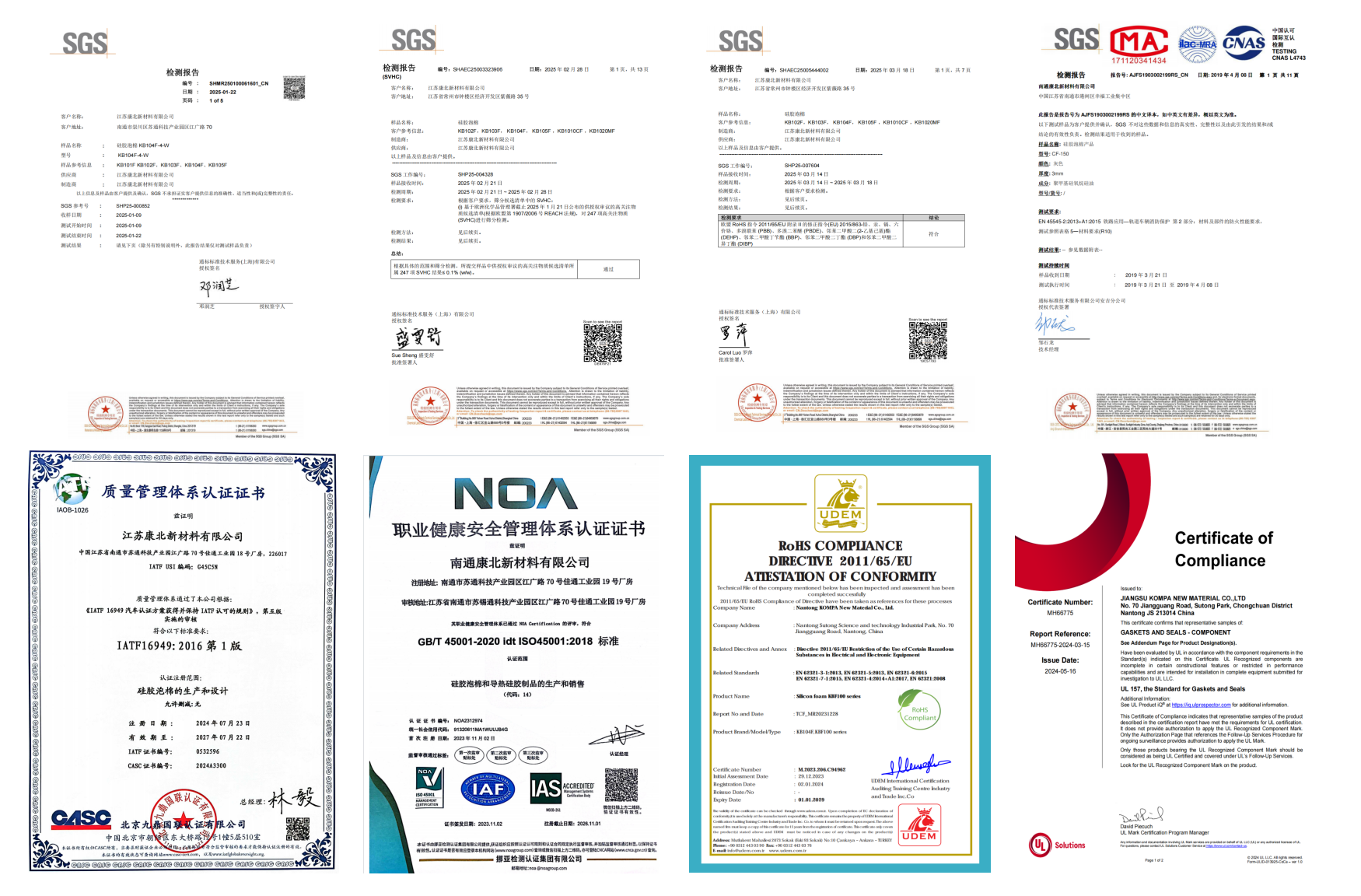
ISO9001, ISO14001, ISO45001, IATF16949, EN45545-2, UL94-V0, NSF61, UL157-2007 Gaskets and Seals. CE, ROHS, PAHS, REACH
Product Description
KOMPA Thermal Structural Adhesive is a high-performance polyurethane-based thermal conductive structural adhesive developed for electric vehicle batteries, energy storage batteries, and advanced battery PACK applications.
The adhesive is designed to provide both structural bonding and thermal management within battery systems. It is primarily used for bonding battery cells to liquid cooling plates, bonding battery cells to each other, and bonding reinforcement ribs to liquid cooling plates.
In modern EV and energy storage battery systems, the adhesive layer is required to perform more than a simple mechanical bonding function. Battery cells must be securely fixed within the PACK while heat generated during charging and discharging must be effectively transferred to the cooling system.
KOMPA Thermal Structural Adhesive integrates these two functions into one material system.
It can be used as part of the thermal transfer path between battery cells and liquid cooling plates, while providing reliable structural bonding and assembly stability.
Typical applications include:
Cell-to-liquid cooling plate bonding
Cell-to-cell structural bonding
Liquid cooling plate reinforcement
Battery PACK assembly
EV battery thermal management
Energy storage battery systems
KOMPA New Materials Research Institute develops high-performance polymer materials from the molecular level. By designing specific polymer molecular structures and molecular weight systems, KOMPA can develop application-specific adhesive solutions according to different battery designs and customer requirements.
Different battery PACK structures, cell formats, cooling systems, and manufacturing processes require different material properties. Therefore, KOMPA focuses on developing customized polymer materials that are more closely matched to the actual requirements of downstream battery applications.
In addition to thermal structural adhesives, KOMPA provides integrated polymer and high-temperature insulation material solutions for battery PACK manufacturers.
KOMPA Thermal Structural Adhesive features a controlled semi-flowable formulation designed for industrial bonding applications.
The material provides a balance between flowability and application control.
It can spread effectively across the bonding interface while maintaining controlled flow during assembly.
This property is especially important for battery applications where the adhesive needs to cover a relatively large bonding area.
The semi-flowable formulation can help:
Improve surface coverage
Reduce interfacial gaps
Enhance contact between substrates
Improve application consistency
Support automated dispensing processes
The balance between flowability and stability is important for cell-to-cooling plate bonding.
An adhesive with excessive flow may migrate outside the target bonding area, while an adhesive with insufficient flow may not provide adequate interface wetting.
KOMPA develops the rheological characteristics of the adhesive according to the requirements of battery assembly processes.
Excellent interface wetting is one of the key requirements for reliable battery bonding.
Battery cells, liquid cooling plates, and aluminum reinforcement structures may have microscopic surface irregularities.
A thermal structural adhesive must be able to effectively wet the bonding surfaces and create a stable interface.
KOMPA Thermal Structural Adhesive provides excellent interface wetting performance.
This can help improve:
Effective bonding area
Adhesive-substrate contact
Bonding reliability
Interface consistency
Thermal transfer efficiency
When used between a battery cell and a liquid cooling plate, good interface wetting is particularly important because the adhesive layer may also form part of the heat transfer path.
Battery systems may be exposed to humidity, condensation, and changing environmental conditions throughout their service life.
Moisture can negatively affect:
Adhesive interfaces
Metal substrates
Electrical components
Long-term material durability
KOMPA Thermal Structural Adhesive features excellent hydrophobicity to help improve resistance to moisture-related degradation.
The high hydrophobicity of the material is suitable for applications requiring long-term performance under demanding environmental conditions.
Potential applications include:
Electric vehicle battery packs
Energy storage battery systems
Outdoor energy storage equipment
Liquid-cooled battery systems
The adhesive demonstrates excellent performance under Double 85 environmental conditions.
Double 85 testing generally refers to exposure to:
Temperature: 85°C
Relative Humidity: 85%
This accelerated aging environment is widely used to evaluate the long-term durability of materials under combined high-temperature and high-humidity conditions.
Excellent Double 85 performance helps support the reliability requirements of battery applications where adhesive materials may be exposed to:
High temperature
High humidity
Thermal cycling
Long-term environmental aging
This property is particularly important for EV batteries and energy storage systems that require long-term reliability.
KOMPA Thermal Structural Adhesive provides excellent adhesion to 3003 aluminum.
3003 aluminum is widely used in battery thermal management systems and liquid cooling plate structures.
The adhesive is suitable for bonding applications involving:
3003 aluminum liquid cooling plates
Aluminum reinforcement ribs
Aluminum structural components
Battery thermal management assemblies
Reliable adhesion to aluminum is important because the bonding interface may be exposed to repeated thermal expansion and contraction during battery operation.
The key advantage of a thermal conductive structural adhesive is its multifunctional performance.
Traditional structural adhesives are mainly used for mechanical bonding.
Thermal interface materials are mainly used for heat transfer.
KOMPA Thermal Structural Adhesive is designed to combine both functions.
The adhesive can help:
Fix battery components
Maintain structural stability
Improve interface contact
Support heat transfer
Simplify material integration
This integrated approach is particularly suitable for advanced EV battery and energy storage system designs.
| Property | Description |
|---|---|
| Product Name | Thermal Structural Adhesive |
| Alternative Name | Thermal Conductive Structural Adhesive |
| Base Chemistry | Polyurethane |
| Material Type | Thermally Conductive Structural Adhesive |
| Appearance | Customized according to formulation |
| Rheology | Semi-Flowable |
| Main Functions | Structural Bonding and Thermal Management |
| Interface Wetting | Excellent |
| Hydrophobicity | Excellent |
| Double 85 Performance | Excellent |
| Aluminum Adhesion | Excellent adhesion to 3003 aluminum |
| Main Substrate | Aluminum and battery-related substrates |
| Main Application | EV Battery and Energy Storage Battery |
| Typical Application | Cell-to-Cold Plate Bonding |
| Other Applications | Cell-to-Cell Bonding / Cooling Plate Reinforcement |
| Application Method | Industrial Dispensing |
| Customization | Available |
The specific technical data may vary according to the final formulation, application conditions, and customer requirements. Please contact KOMPA for detailed technical data and application-specific recommendations.
Looking for a thermal conductive structural adhesive for EV batteries, energy storage systems, or liquid cooling plate assemblies?
KOMPA provides application-specific polyurethane adhesive solutions for battery PACK manufacturers and new energy companies.
Our technical team can support:
Product selection
Sample development
Application evaluation
Customized polymer development
Battery material solutions
Contact KOMPA today to discuss your application requirements and develop a suitable thermal structural adhesive solution for your battery project.
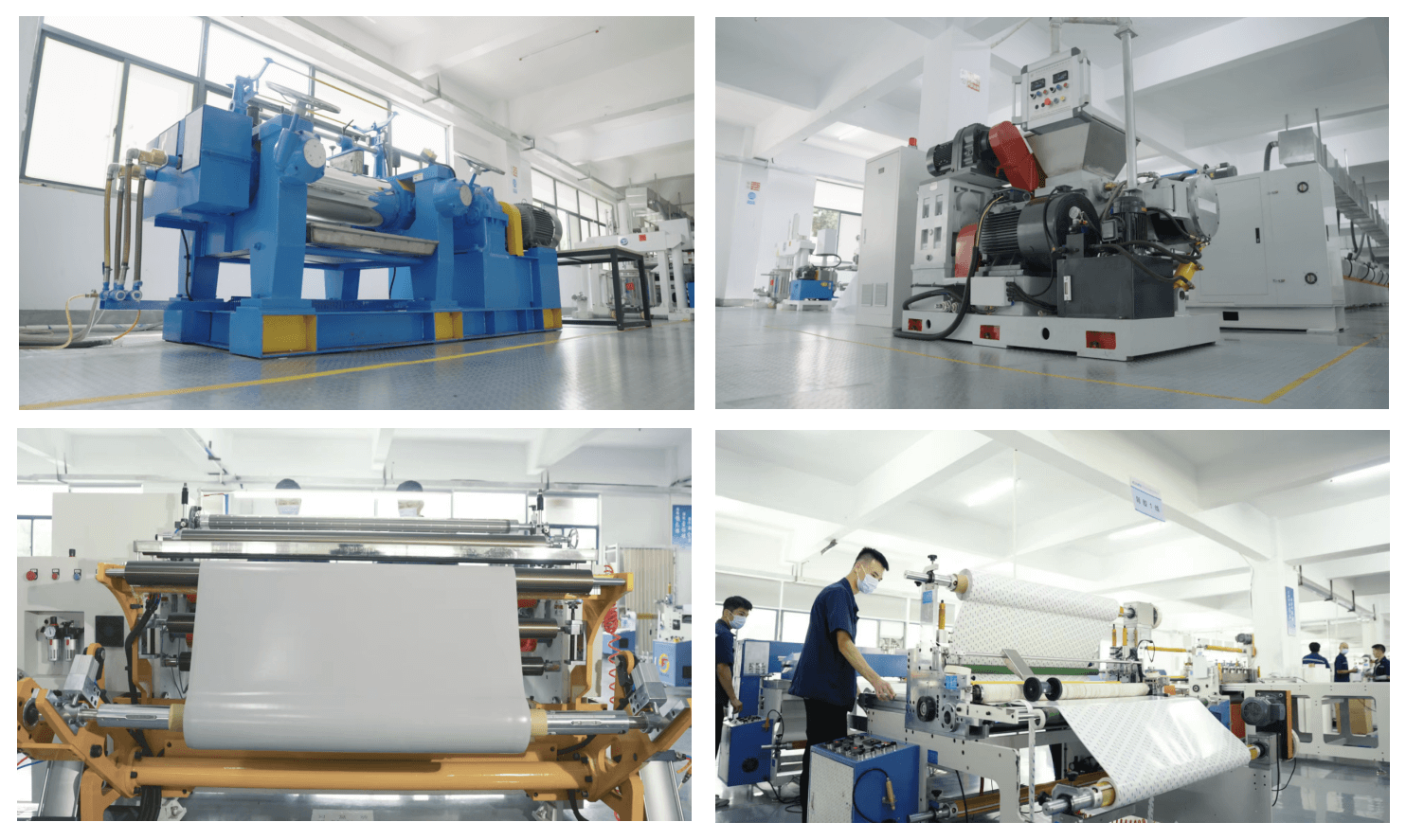
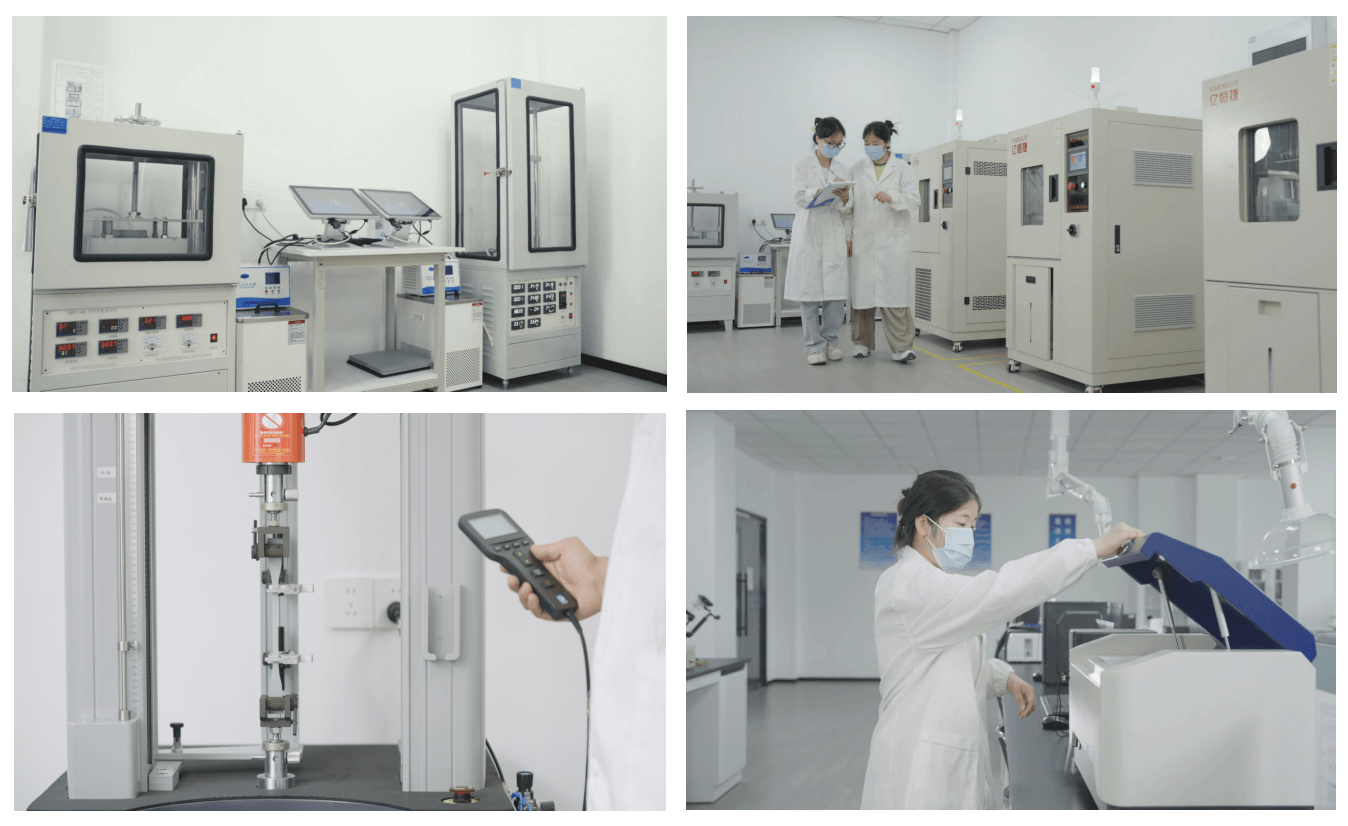
Factory Video
EV battery packs and energy storage systems
On-board chargers (OBC), inverters, and BMS units
IGBT & MOSFET power modules
LED lighting & telecom base stations
Consumer electronics & industrial control boards
KOMPA Thermal Structural Adhesive can be developed and supplied according to the customer's application and production process.
Packaging formats can be customized according to the material system and dispensing equipment.
Potential packaging options may include:
Cartridge packaging
Industrial containers
Customized packaging systems
The final packaging format should be selected according to:
Adhesive viscosity
Component configuration
Dispensing equipment
Production volume
Storage requirements
The semi-flowable formulation is suitable for industrial adhesive application processes.
Depending on the customer's production line, the adhesive can be evaluated for:
Manual dispensing
Semi-automatic dispensing
Automated dispensing
Meter-mixing dispensing systems
Application parameters can be optimized according to the required adhesive quantity, bonding area, and production cycle.
KOMPA can develop customized thermal structural adhesive solutions according to specific customer requirements.
Customization may consider:
Battery cell type
Battery PACK design
Cooling system structure
Substrate material
Required thermal performance
Adhesive application process
Curing requirements
Environmental conditions
This enables the adhesive to be developed for the actual application rather than simply selected from a standard product range.
KOMPA Thermal Structural Adhesive is primarily designed for new energy vehicle battery applications.
It can be used for:
Battery cell bonding
Cell-to-liquid cooling plate bonding
Cell-to-cell bonding
Battery PACK structural bonding
Thermal management integration
During battery operation, cells generate heat during charging and discharging.
The thermal structural adhesive can help establish a thermal transfer interface between the battery cell and liquid cooling system while also providing structural fixation.
Cell-to-liquid cooling plate bonding is one of the main applications of thermal structural adhesive.
A typical structure is:
Battery Cell → Thermal Structural Adhesive → Liquid Cooling Plate → Cooling Medium
In this structure, the adhesive provides both:
Structural bonding
Thermal interface support
Excellent interface wetting helps the adhesive contact the bonding surfaces effectively.
The semi-flowable consistency allows the material to spread across the target bonding area while maintaining controlled application behavior.
The adhesive is suitable for battery architectures that require the integration of mechanical bonding and thermal management.
Thermal structural adhesive can also be used for bonding between battery cells.
The adhesive may help provide:
Cell positioning
Structural fixation
Assembly stability
Vibration resistance
The exact adhesive design should be selected according to the cell type, cell arrangement, bonding area, and production requirements.
KOMPA can provide customized material development for different battery structures.
Energy storage systems require reliable structural materials capable of long-term operation.
KOMPA Thermal Structural Adhesive can be used in applications including:
Energy storage battery PACKs
Industrial energy storage systems
Commercial energy storage systems
Liquid-cooled energy storage batteries
The material's hydrophobicity and Double 85 performance support applications requiring durability under demanding environmental conditions.
Liquid cooling plates may require reinforcement ribs or additional structural components to improve their mechanical stability.
KOMPA Thermal Structural Adhesive can be used for bonding:
Reinforcement ribs
Aluminum structures
Cooling plate components
Battery thermal management components
The excellent adhesion to 3003 aluminum makes the material suitable for liquid cooling plate reinforcement applications.
As battery energy density continues to increase, effective thermal management becomes increasingly important.
Thermal structural adhesive can become part of the interface between the heat-generating battery cell and the cooling system.
The adhesive helps integrate:
Mechanical fixation
Interface contact
Thermal management
This multifunctional performance can help simplify the material structure of battery PACK systems.
KOMPA New Materials Research Institute develops polymer materials from the molecular level.
By designing specific polymer structures and molecular weight systems, we can optimize material properties according to actual application requirements.
This approach enables the development of materials with a balanced combination of:
Adhesion
Flexibility
Mechanical performance
Thermal management capability
Environmental durability
Different battery designs require different adhesive solutions.
KOMPA can develop products according to:
Battery cell structure
Battery PACK architecture
Liquid cooling system
Substrate material
Bonding area
Production process
Environmental conditions
The objective is to provide a material solution that matches the customer's actual application.
KOMPA focuses on advanced materials for new energy and industrial applications.
Our product portfolio includes:
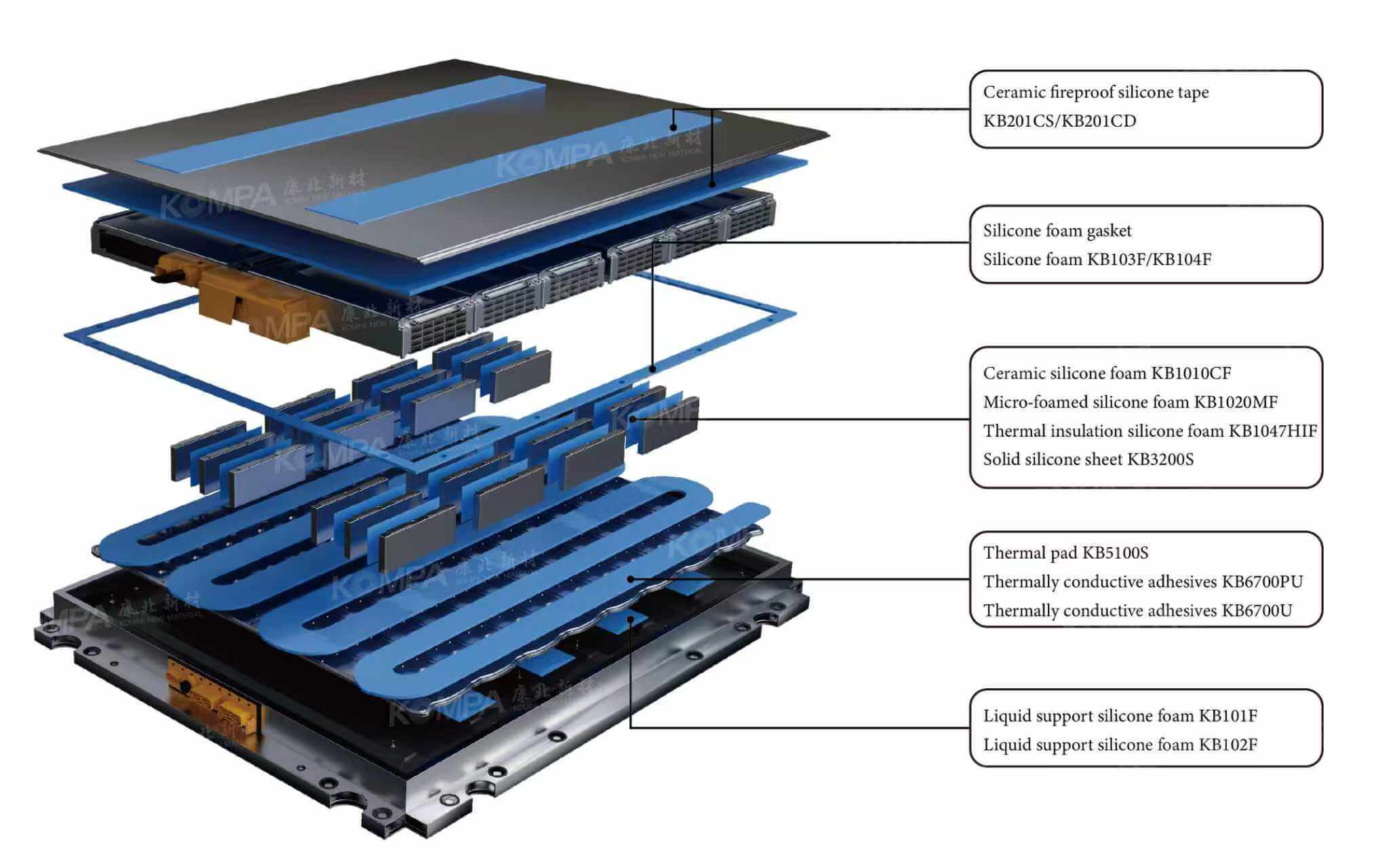
Thermal structural adhesives
Silicone foam
Thermal pads
Thermal insulation materials
High-temperature insulation materials
Ceramic fire-resistant silicone materials
Thermal potting materials
This allows KOMPA to provide integrated material solutions for battery PACK manufacturers.
A modern battery PACK may require multiple material technologies.
Different components may require:
Structural bonding
Thermal management
Electrical insulation
Thermal insulation
Fire protection
Sealing and cushioning
KOMPA can support customers with a broader portfolio of polymer and high-temperature material solutions.
This helps customers coordinate material development across different parts of the battery system.
KOMPA works with customers to understand their actual application requirements.
Technical development may include:
Application analysis
Material selection
Sample development
Bonding evaluation
Substrate compatibility testing
Process optimization
For projects requiring customized performance, our technical team can work with customers to develop application-specific solutions.
Thermal structural adhesive is an adhesive material that combines structural bonding with thermal management functionality.
It is designed to mechanically bond components while also supporting heat transfer through the adhesive interface.
It is mainly used for:
Bonding battery cells to liquid cooling plates
Bonding battery cells to each other
Bonding liquid cooling plate reinforcement ribs
Integrating structural bonding and thermal management
Yes. KOMPA Thermal Structural Adhesive is designed to provide excellent adhesion to 3003 aluminum.
This makes it suitable for liquid cooling plates and aluminum reinforcement structures.
Yes. The product is a polyurethane-based thermal conductive structural adhesive designed for new energy battery applications.
Double 85 refers to an accelerated environmental aging condition of approximately 85°C and 85% relative humidity.
It is used to evaluate the durability of materials under combined high-temperature and high-humidity conditions.
Yes. The adhesive can be used in energy storage battery systems requiring structural bonding and thermal management.
The final material selection should be based on the specific battery design and operating conditions.
Yes. KOMPA can develop customized thermal structural adhesive solutions according to the customer's:
Battery structure
Substrate material
Cooling system
Application process
Environmental requirements
To recommend a suitable solution, customers are encouraged to provide:
Substrate materials
Bonding area
Battery cell type
Cooling system design
Required adhesive thickness
Application method
Operating temperature
Environmental requirements
This information helps KOMPA evaluate the application and develop a more suitable material solution.
Each carton is labeled with product code, lot number, and specification details.
Store in a dry, ventilated area away from direct sunlight
Recommended storage temperature: normal temperature
Avoid heavy pressure or sharp objects
Shelf life: 12 months from production date if unopened and properly stored
Vacuum packaging for long-term storage
Die-cut parts on release liner roll or sheet
Barcode or QR-code labeling
Inner trays or custom-fit foam inserts for precision parts
OEM or neutral packaging available upon request
Moisture-proof and dust-proof wrapping
Export-ready wooden pallets for large volume shipments
Global shipping via air, sea, or courier
Lead time: 7–10 working days based on order volume and customization
Express prototyping support for urgent projects

Huawei – Global leader in communications, smart devices, and energy solutions
ZENERGY – Trusted supplier specializing in new energy battery systems
SAIC Motor – One of China’s largest and most innovative automotive manufacturers
Dongfeng Motor – Leading state-owned company in commercial and passenger vehicles
CRRC – World’s largest manufacturer of rail transit equipment and systems
CALB – Global innovator in lithium battery technology and energy storage solutions